John Porter
and
Margaret _______
Born: Saffron Walden (?) Essex, UK
Died: 6 Sep 1676, Kingston RI
Buried:
Born: c 1590, Essex UK
Died: 1681, Portsmouth, RI
Buried:
Married: Essex UK
Children: Hannah
John Porter arrived in New England by 1633, with wife Margarret, step-daughter Sarah Odding, and daughter Hannah, when he and his wife were listed as members of the church at Roxbury in the Massachusetts Bay Colony. There are few, if any, records of him in Roxbury, or his next residence of Boston, until a major theological rift arose in the colony, often called the Antinomian Controversy, when he became attracted to the preachings of the dissident ministers John Wheelwright and Anne Hutchinson, signing a petition in support of Wheelwright. Following the banishment of these two individuals from the Massachusetts Colony, Porter and many other followers were disarmed when on 20 November 1637 he and others were ordered to deliver up all guns, pistols, swords, powder and shot because the "opinions and revelations of Mr. Wheelwright and Mrs. Hutchinson have seduced and led into dangerous errors many of the people here in New England."
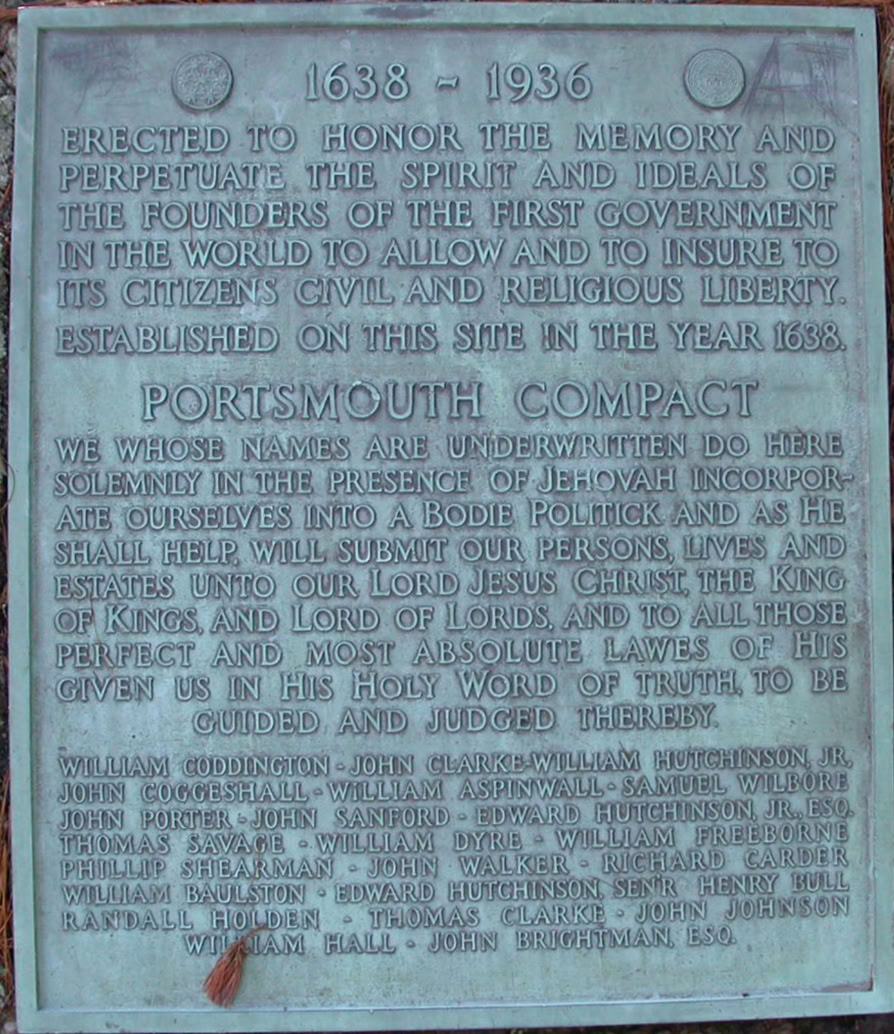
Scores of the followers of Wheelwright and Hutchinson were ordered out of theMassachusetts Colony, but before leaving, a group of them, including Porter, Samuel Wilbore (father of his future son-in law), and Randall Holden, signed what is sometimes called the Portsmouth Compact, establishing a non- sectarian civil government upon the universal consent of the inhabitants, with a Christian focus. Planning initially to settle in New Netherland, the group was persuaded by Roger Williams to purchase some land of the Indians on the Narragansett Bay. This they did, settling on the north east end of Aquidneck Island, and establishing a settlement they called Pocasset, but in 1639 changing the name to Portsmouth. In 1640 he was elected to his first of six terms as Assistant to the President, and then much later, in 1658, he was chosen as a Commissioner for three years. In 1661 he was on a committee to raise money for obtaining a royal charter, and when the charter was delivered in November 1663, he was named as one of the ten Assistants to the Governor.
In January 1658 Porter joined a group of other settlers in buying from some Indian sachems a large tract of land on the west side of the Narragansett Bay called the Pettaquamscutt Purchase, a tract which would later become South Kingstown. Within a few years of the purchase, Porter abandoned his wife Margaret and moved to his new land without her. In May 1665 she petitioned the Assembly that her husband did not give her suitable care, and had left her, causing her to be dependent on her children, and desiring suitable provision from Porter's estate for her support. The court, satisfied that the complaints were valid and "having a deep sense upon their hearts of this sad condition which this poor ancient matron is by this means reduced into," ordered that the real and personal estate of Porter remaining in their jurisdiction be secured until his wife was given appropriate support. The following month Porter made ample provision for his wife, and was thus released from the restraint upon his estate.
During the next few years Porter began a relationship with Herodias Gardiner, the former common-law wife of George Gardiner. (Herodias lived in Newport with Gardiner for about 20 years after leaving her husband, until she petitioned the court to force Gardiner to leave her alone.) In October 1667 an indictment was made "against Mr. John Porter of Narragansett in the King's Province and Harrud Long alias Gardiner for that they are suspected to cohabit and so to live in way of incontinency". The following May, Porter appeared in court and was acquitted, and the next October Herodias was similarly charged, and acquitted as well. It is uncertain if Porter ever married Herodias, but she co-signed several deeds with him in 1671.
—Adapted from Wikipedia