Surrey Families
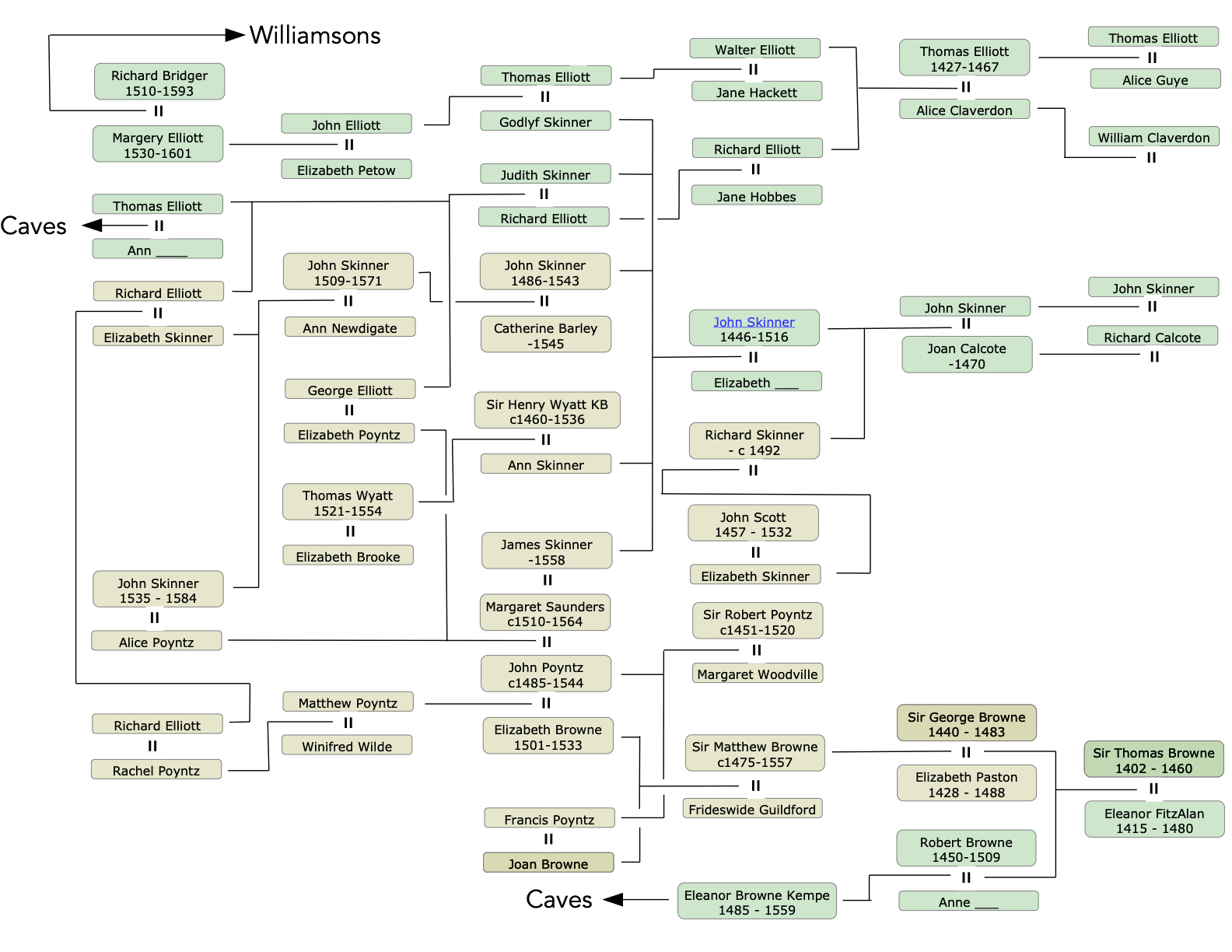
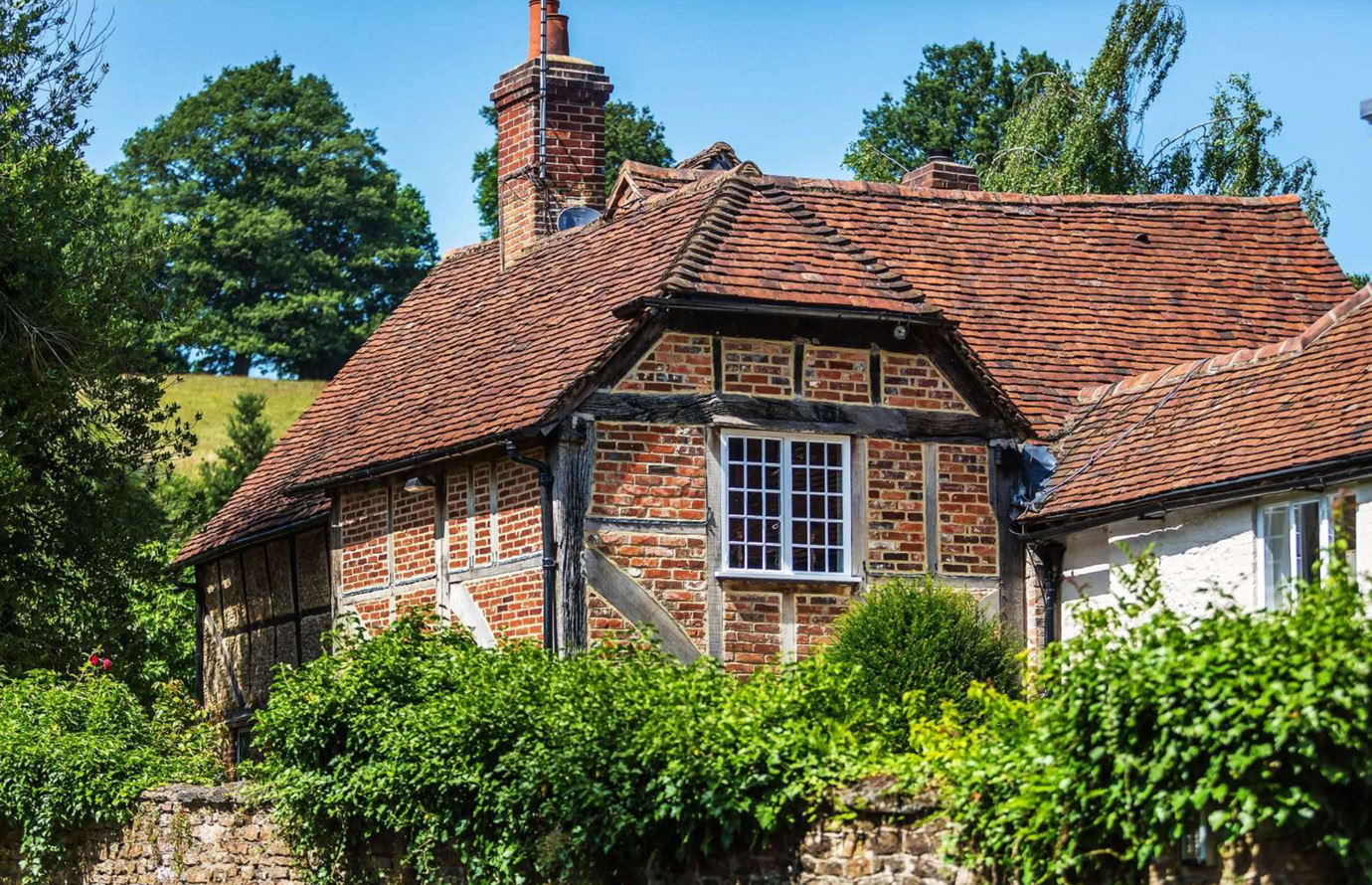
It was wool which made England wealthy in the Middle Ages, and one center for the manufacture of wool cloth was Godalming Surrey. The Elliotts were members of a group of families- including the Bridgers and Petows- in the Godalming area who grew quite prosperous in the wool trade during the fifteenth and sixteenth centuries. The first recorded member of the Elliotts is Thomas, whose fifteenth century house, Green Place, still stands in Wonersh, just northeast of Godalming.
The Elliotts were merchants, first in the wool trade in Surrey and later in various businesses in London (Thomas, husband of Ann, was a London draper), and mostly stuck to commerce. However, the families with which they intermarried, particularly the Skinners and their kin, played a significant role in Surrey politics in Tudor times. The Skinners had been involved in Surrey government for several hundred years (see John Skinner for some details) several also held positions at court, and they became allied with one of the groups contending for dominance in Surrey.
In the early 16th century. Surrey was a battleground between two political factions,1 one lead by the Howards- the family of the Duke of Norfolk- and the other lead by Sir Matthew Browne and John Scott. (Browne hated the Howards for their role in defeating an uprising against Richard III, after which his father George Browne was beheaded.) The battles between the two factions were fought in courtrooms, in the Surrey Commission of the Peace (essentially the governing body of the county at the time), and in the streets and fields of Surrey. In one particularly egregious incident, Browne and his followers destroyed the Duke’s rabbit warrens in Reigate; that case ended up in the Star Chamber in Westminster, after which Browne was (briefly) imprisoned.
It is not clear whether the Elliotts and Skinners intermarried with the Browne and Scott family because they were political allies, or they became political allies because they had intermarried.
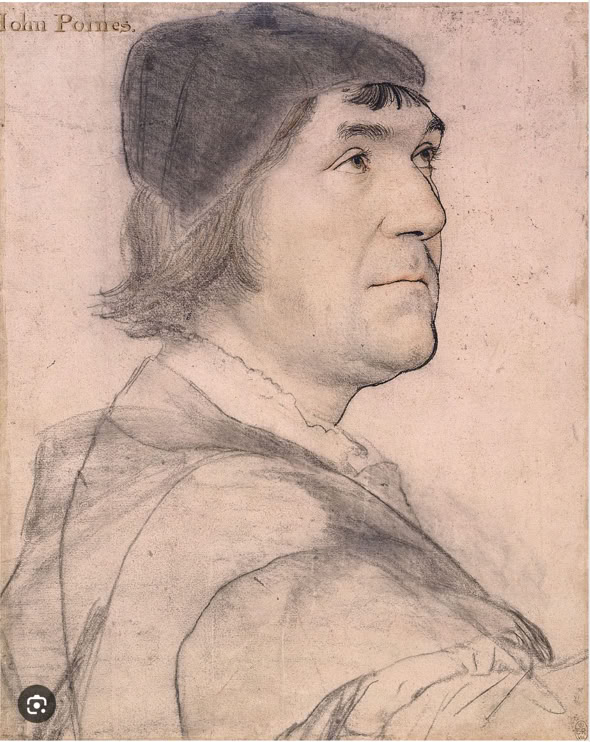
John Poyntz, by Hans Holbein the younger
John Skinner’s neice, Elizabeth, married John Scott, and a battle over the estate of Elizabeth’s father, Richard, became a long-running part of the war between the two factions. The Skinner/Elliott family connection with Matthew Browne came through the children of John Poyntz. The Poyntz’s were a very well-connected family of Gloucestershire gentry (John was second cousin to Henry VIII). John and his brother married two daughters of Matthew Browne, and John’s children- by both of his wives- married Elliotts and Skinners multiple times. The first such marriage, between James Skinner and Margaret Saunders Poyntz, John’s widow, also allied the Skinners with the Saunders, another important Surrey family, who- like the Skinners, Brownes, and Poyntzs- were religious conservatives, opposed to the Protestant
innovations being imposed on England by the Seymours and Edward VI. Discarding old grudges, they joined in this fight with the Howards, who were- and remain to this day- the premier Catholic family in England. Most of the family members remained in the Church of England, but several branches, including Saunders, Brownes and Poyntzs, were noted recusants, subject to fines and imprisonment under Queen Elizabeth for their loyalty to the Catholic faith.
______________________________________
1 Many more details can be found in W.B. Robinson, The Justices of the Peace of Surrey in National and County Politics, 1483-1570